Opening
Apertura
Blood-red stones and vivid green grass
Sassi sanguigni e erbe verdissime
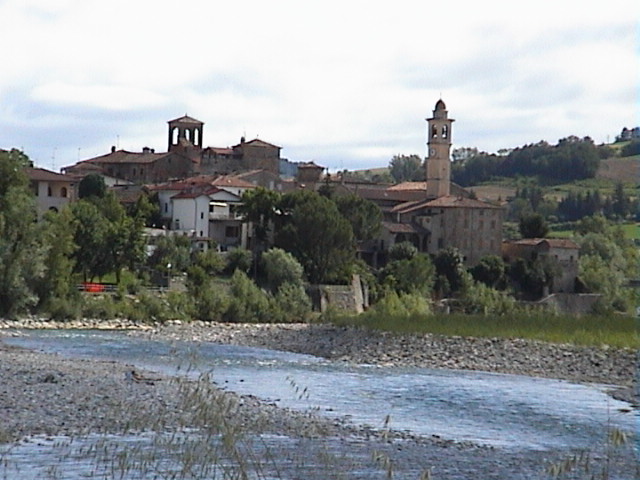
The Val Trebbia is still there. You can go today. A river running clear over limestone, steep wooded slopes of chestnut and oak coming down to the water, and everywhere the old stone walls — the terraces that families built by hand over centuries on the hillsides. The poet Giorgio Caproni, who lived in this valley for much of his life and asked to be buried there, described it in a letter to a friend as a strange zone of blood-red stones and vivid green grass, a place where the people still carry ancient blood in their veins. He wrote that in 1947. The description would have served equally well in 1847, or 1797.
La Val Trebbia è ancora lì. Ci si può andare oggi. Un fiume che scorre limpido sulla pietra calcarea, ripidi versanti boscosi di castagni e querce che scendono verso l'acqua, e dappertutto i vecchi muri di pietra — i terrazzamenti che le famiglie costruivano a mano per secoli sulle falde collinari. Il poeta Giorgio Caproni, che visse in questa valle per gran parte della sua vita e chiese di essere sepolto lì, la descrisse in una lettera a un amico come una strana zona di sassi sanguigni e d'erbe verdissime, un luogo dove la gente conserva ancora sangue antico nelle vene. Lo scrisse nel 1947. La descrizione sarebbe valsa ugualmente nel 1847, o nel 1797.
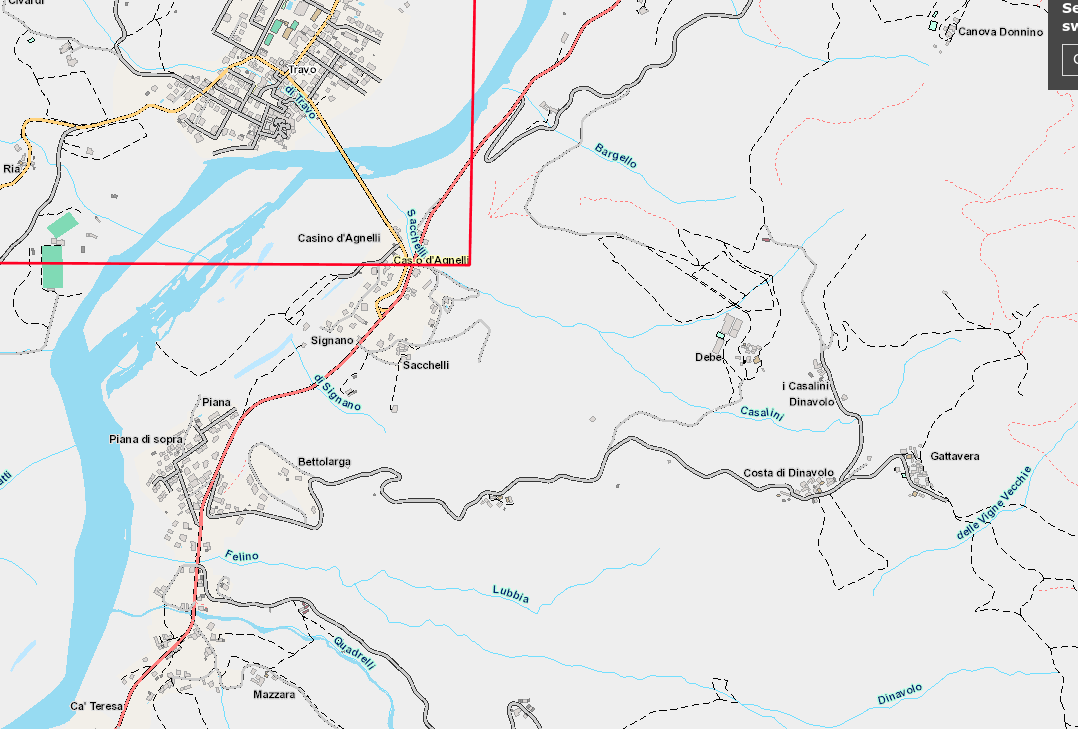
This is a story about a family from that valley. They were called Bassi. They lived on a hillside above the Trebbia, at a farmstead named Villa Gattavera, in the locality of Dinavolo, in the commune of Travo. They farmed the land for as far back as the records reach. Then, one generation, a son left — and the thread of the valley was carried to London, where it became something else entirely.
Questa è la storia di una famiglia di quella valle. Si chiamavano Bassi. Vivevano su un versante sopra il Trebbia, in una cascina chiamata Villa Gattavera, nella località di Dinavolo, nel comune di Travo. Coltivavano la terra da quanto i documenti permettono di risalire. Poi, in una generazione, un figlio partì — e il filo della valle fu portato a Londra, dove divenne qualcosa di completamente diverso.
· · ✦ · ·
Chapter One
Capitolo Primo
The hillside at Dinavolo
Il versante di Dinavolo
To understand the Bassi family, you have to understand the hillside. Not as a romantic landscape — though it is beautiful — but as a thing that had to be built, maintained, and defended against gravity and rain every single year.
Per capire la famiglia Bassi, bisogna capire il versante. Non come paesaggio romantico — pur essendo bellissimo — ma come una cosa che doveva essere costruita, mantenuta e difesa dalla gravità e dalla pioggia ogni singolo anno.
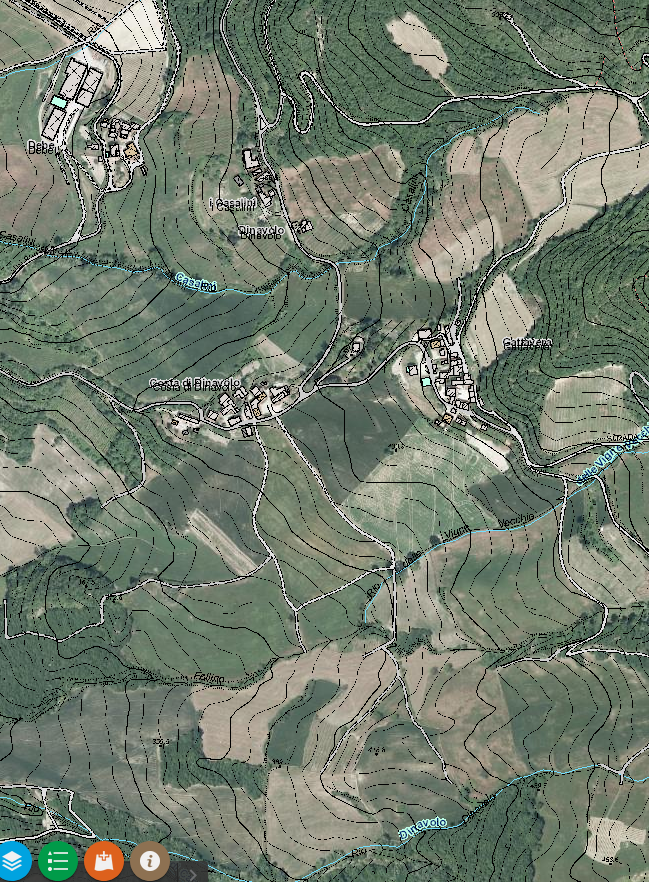
The hillside above the Trebbia at Dinavolo did not look the way it does naturally. Every strip of cultivable ground was a terrace, held up by a dry-stone wall built from the valley's blood-red sandstone. These walls did not build themselves. Attilio Carboni, a local historian who grew up in this valley and wrote about it in the newspaper La Trebbia for many years, described how the building and maintenance of the stone terraces was a source of intense communal pride — families competing with each other to lay the most precise, the most durable course of stone, to have the neatest wall and the most productive strip. The work required patience above all: finding exactly the right stone, testing it, sometimes rejecting it and searching again. A wall that failed in winter rains meant crops lost in spring.
Il versante sopra il Trebbia a Dinavolo non aveva l'aspetto naturale. Ogni striscia di terreno coltivabile era un terrazzamento, sorretto da un muro a secco costruito con la pietra arenaria color sangue della valle. Questi muri non si costruivano da soli. Attilio Carboni, storico locale cresciuto in questa valle e che vi scrisse per anni sul giornale La Trebbia, descriveva come la costruzione e la manutenzione dei terrazzamenti in pietra fosse fonte di intensa orgoglio comunitario — famiglie in competizione per posare il filare di pietra più preciso e durevole. Il lavoro richiedeva pazienza soprattutto: trovare esattamente la pietra giusta, provarla, a volte scartarla e cercarne un'altra. Un muro che cedeva nelle piogge invernali significava raccolti persi in primavera.
The farmhouse at Villa Gattavera would have been built the same way: local stone, thick walls, small windows. The ground floor was shared with the animals in winter — their warmth rising through the floor above. There was a covered portico — a loebia — where the family could work in bad weather. There was a hay barn, a yard, a spring for washing. No running water. No electricity. Heat from a single fireplace burning chestnut wood.
La cascina a Villa Gattavera era stata costruita allo stesso modo: pietra locale, muri spessi, finestre piccole. Il piano terra era condiviso con gli animali in inverno — il loro calore saliva attraverso il pavimento superiore. C'era un portico coperto — una loebia — dove la famiglia poteva lavorare con il brutto tempo. C'era un fienile, un cortile, una sorgente per lavare. Niente acqua corrente. Niente elettricità. Calore da un unico camino che bruciava legno di castagno.
From the farmhouse door, on a clear day, you could look down through the chestnut trees to the glitter of the Trebbia far below, and across to the opposite hillside rising steeply toward the Apennine ridge. In October the chestnut forests above would be full of family members gathering the harvest — the great crop, the one that fed the valley through winter, dried and ground into flour for bread and porridge and polenta. Every autumn, the same work. Every winter, the same store of flour, getting smaller month by month until spring. Every spring, the relief of fresh vegetables and the knowledge that you had made it through.
Dalla porta della cascina, in una giornata limpida, si poteva guardare giù attraverso i castagni verso il luccichio del Trebbia lontano in basso, e dall'altra parte verso il versante opposto che saliva ripido verso il crinale appenninico. In ottobre i boschi di castagni sopra sarebbero stati pieni di familiari che raccoglievano il raccolto — il grande prodotto, quello che sfamava la valle durante l'inverno, essiccato e macinato in farina per pane, polenta e pappe. Ogni autunno, lo stesso lavoro. Ogni inverno, la stessa scorta di farina, che si assottigliava mese per mese fino alla primavera. Ogni primavera, il sollievo delle verdure fresche e la consapevolezza di essere sopravvissuti.
The road to Travo — two or three kilometres down the hill — was the connection to everything beyond the farmstead. Molossi, who surveyed this territory in 1832, recorded that the road from Rivergaro was passable by wheeled cart only as far as Travo. Beyond that, a mule track into the mountains. Travo was the end of the cart road, the last point where the wider world could reach you. Salt came up from Genoa along this road. Wool, oil, tools, news — all of it arrived by mule. All of it passed through Travo. The Anguissola family in their castle had once taxed that traffic. They still cast a long shadow over the valley.
La strada per Travo — due o tre chilometri giù per il colle — era il collegamento con tutto ciò che stava al di là della cascina. Molossi, che rilevò questo territorio nel 1832, registrò che la strada da Rivergaro era percorribile con carri a ruote solo fino a Travo. Oltre, un sentiero per muli verso le montagne. Travo era la fine della strada carrozzabile, l'ultimo punto dove il mondo più ampio poteva raggiungerti. Il sale saliva da Genova lungo questa strada. Lana, olio, attrezzi, notizie — tutto arrivava col mulo. Tutto passava per Travo.
· · ✦ · ·
Chapter Two
Capitolo Secondo
Giuseppe and Rosa
Giuseppe e Rosa
Giuseppe Bassi was born around 1798, into a world that was already in upheaval. The French were in northern Italy. Napoleon had reorganised the old Duchy of Piacenza, imposed civil registration, demanded conscription. Young men from Bobbio and Travo and the valley communes were called up — we know from a surviving list in the Bobbio archive that in 1806 alone, fourteen of the twenty-three men conscripted from Bobbio were contadini, peasant farmers like Giuseppe. Napoleon himself commented on the Piacenzans — he called them great rascals, and said that shooting a couple of them would set things right. It was the world into which Giuseppe grew up: a world where the state had acquired both the power to record you at birth and the power to take you away to die in someone else's war.
Giuseppe Bassi nacque intorno al 1798, in un mondo già in tumulto. I Francesi erano nell'Italia settentrionale. Napoleone aveva riorganizzato il vecchio Ducato di Piacenza, imposto la registrazione civile, richiesto la coscrizione. I giovani di Bobbio e Travo e dei comuni della valle venivano chiamati alle armi — sappiamo da una lista conservata nell'archivio di Bobbio che nel solo 1806, quattordici dei ventitré uomini coscritti da Bobbio erano contadini, contadini come Giuseppe. Napoleone stesso commentò i piacentini — li chiamò grandi birboni, e disse che fucilarne un paio avrebbe sistemato le cose. Era il mondo in cui Giuseppe crebbe.
After Napoleon fell, the Duchy passed to Maria Luigia of Austria — Napoleon's own wife — who governed it cautiously and competently for thirty years. Civil registration continued. It is because of this system, imposed under military threat and maintained by Maria Luigia, that we can find the Bassi family at all. Without it, they would be invisible to history.
Dopo la caduta di Napoleone, il Ducato passò a Maria Luigia d'Austria — la moglie di Napoleone — che lo governò con cautela e competenza per trent'anni. La registrazione civile continuò. È grazie a questo sistema, imposto sotto minaccia militare e mantenuto da Maria Luigia, che possiamo trovare la famiglia Bassi. Senza di esso, sarebbero invisibili alla storia.
Giuseppe married Rosa Maggi before April 1827 — we cannot find the marriage record, which means it happened before civil registration reached this corner of the valley, or before the Travo registers begin. The priest at Sant'Antonino Martire would have recorded it in his parish book. That book is now held at the Archivio Diocesano in Piacenza. We have written to ask. When the reply comes, we will learn when and where they married, and who their fathers were.
Giuseppe sposò Rosa Maggi prima dell'aprile 1827 — non troviamo l'atto di matrimonio, il che significa che avvenne prima che la registrazione civile raggiungesse questo angolo della valle, o prima che i registri di Travo inizino. Il parroco di Sant'Antonino Martire lo avrebbe registrato nel suo libro parrocchiale. Quel libro è ora conservato all'Archivio Diocesano di Piacenza. Abbiamo scritto per chiedere.
What we have instead are the records of the children they buried. Maria, in April 1827 — probably an infant. Maria Carmilla, in July 1835, aged about one. Antonio Giambattista, in 1841. Another Maria, in 1844. Giambattista, in 1845. At least five children dead before Pietro, born in 1830, reached adulthood. The causes are not recorded. We can guess: the fevers of summer, the cold of winter in a stone farmhouse, the diseases that swept through rural communities without warning or remedy. These were not unusual losses. Every family on every hillside in the valley buried children. It did not make the grief smaller.
Quello che abbiamo invece sono i registri dei figli che seppellirono. Maria, nell'aprile 1827 — probabilmente un neonato. Maria Carmilla, nel luglio 1835, di circa un anno. Antonio Giambattista, nel 1841. Un'altra Maria, nel 1844. Giambattista, nel 1845. Almeno cinque figli morti prima che Pietro, nato nel 1830, raggiungesse l'età adulta. Le cause non sono registrate. Possiamo immaginare: le febbri estive, il freddo invernale in una cascina di pietra, le malattie che si abbattevano sulle comunità rurali senza preavviso né rimedio.
Rosa Maggi does not speak in any document. She appears at the margins: as the mother of children who died, as the fu — the late — in her son's marriage certificate. She was dead by February 1857. Giuseppe outlived her.
Rosa Maggi non parla in nessun documento. Compare ai margini: come madre di figli morti, come il fu — la defunta — nell'atto di matrimonio di suo figlio. Era morta prima del febbraio 1857. Giuseppe le sopravvisse.
But we can say something about what her life was. She knew every chestnut tree on the hillside. She knew which spring ran clearest in July, and where the mushrooms grew after the first October rain. She knew which of her stone terraces was most likely to slip in a wet March, and where the vines needed staking before the wind came. Carboni, writing about an older woman of exactly this world, noted that she could identify her own cut poles at a crowded market, because she knew them individually — they were part of her family. Rosa Maggi would have been the same. The land was not an abstraction for her. It was the thing she worked every day with her hands, and it worked back on her until there was nothing left.
Ma possiamo dire qualcosa di come fosse la sua vita. Conosceva ogni castagno sul versante. Sapeva quale sorgente scorreva più limpida in luglio, e dove crescevano i funghi dopo la prima pioggia di ottobre. Sapeva quale dei suoi terrazzamenti di pietra era più soggetto a cedere in un marzo piovoso, e dove le viti avevano bisogno di sostegno prima che arrivasse il vento. Carboni, scrivendo di una donna anziana di esattamente questo mondo, notava che poteva identificare le proprie pertiche tagliate in un mercato affollato, perché le conosceva individualmente — facevano parte della sua famiglia. Rosa Maggi sarebbe stata uguale.
· · ✦ · ·
Chapter Three
Capitolo Terzo
Pietro — the child who survived
Pietro — il figlio che sopravvisse
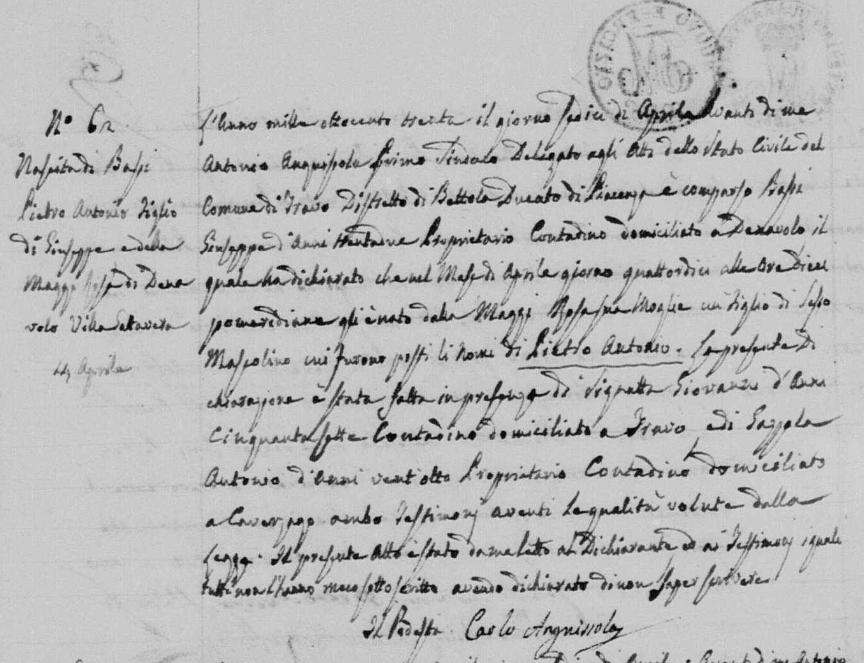
Pietro Antonio Bassi was born on 14 April 1830 at Villa Gattavera. He was the fourth child of Giuseppe and Rosa, and the only one who lived. The civil registrar recorded him as Act No. 61 in the Travo register for that year. His father Giuseppe, aged perhaps 32, described himself as a contadino. The witnesses at the registration were local men, none of whom could write their names — the registrar wrote their details for them.
Pietro Antonio Bassi nacque il 14 aprile 1830 a Villa Gattavera. Era il quarto figlio di Giuseppe e Rosa, e l'unico che visse. L'ufficiale di stato civile lo registrò come atto n. 61 nel registro di Travo per quell'anno. Suo padre Giuseppe, di forse 32 anni, si descrisse come contadino. I testimoni alla registrazione erano uomini del luogo, nessuno dei quali sapeva scrivere il proprio nome — fu il registratore a scrivere i loro dati.
We know almost nothing of Pietro's childhood. He grew up on the hillside watching siblings die. He learned the land from his father, the same as his father had learned it: the rhythms of the chestnut harvest and the vintage, the maintenance of the terraces, the care of the animals, the walk down to Travo on market day. He attended the feast of Sant'Antonino on 4 July — the great annual celebration of the commune's patron saint, the day when the valley came alive with people from every hamlet and farmstead, when the church was full and the market square was busy and you might meet people you hadn't seen since the year before.
Sappiamo quasi nulla dell'infanzia di Pietro. Crebbe sul versante guardando morire i fratelli. Imparò la terra da suo padre, come suo padre l'aveva imparata: i ritmi della raccolta dei castagni e della vendemmia, la manutenzione dei terrazzamenti, la cura degli animali, la camminata fino a Travo il giorno di mercato. Partecipava alla festa di Sant'Antonino il 4 luglio — la grande celebrazione annuale del patrono del comune, il giorno in cui la valle si animava di persone da ogni borgo e cascina.
By 1857 Pietro was 26, and still at the family farm at Dinavolo. We know this because when he went to register his marriage at Ponte dell'Olio on 19 February 1857, the document records his domicile as Danavolo di Travo. He had not left. He had stayed on the land — and in this he was typical of his generation and his world. You stayed until you had to leave, or until there was someone else to stay.
Nel 1857 Pietro aveva 26 anni, e si trovava ancora alla cascina di famiglia a Dinavolo. Lo sappiamo perché quando andò a registrare il suo matrimonio a Ponte dell'Olio il 19 febbraio 1857, il documento registra il suo domicilio come Danavolo di Travo. Non era partito. Era rimasto sulla terra — e in questo era tipico della sua generazione e del suo mondo. Restavi finché non eri costretto ad andare, o finché non c'era qualcun altro a restare.
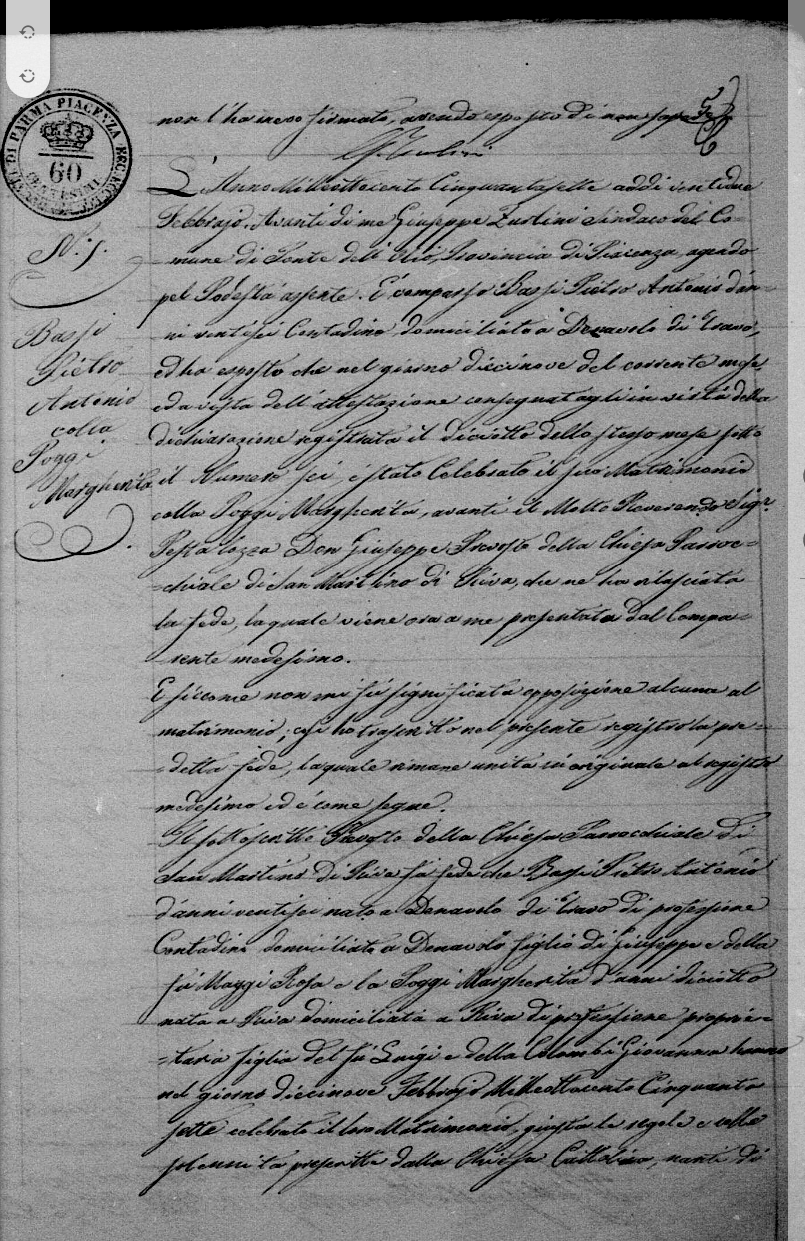
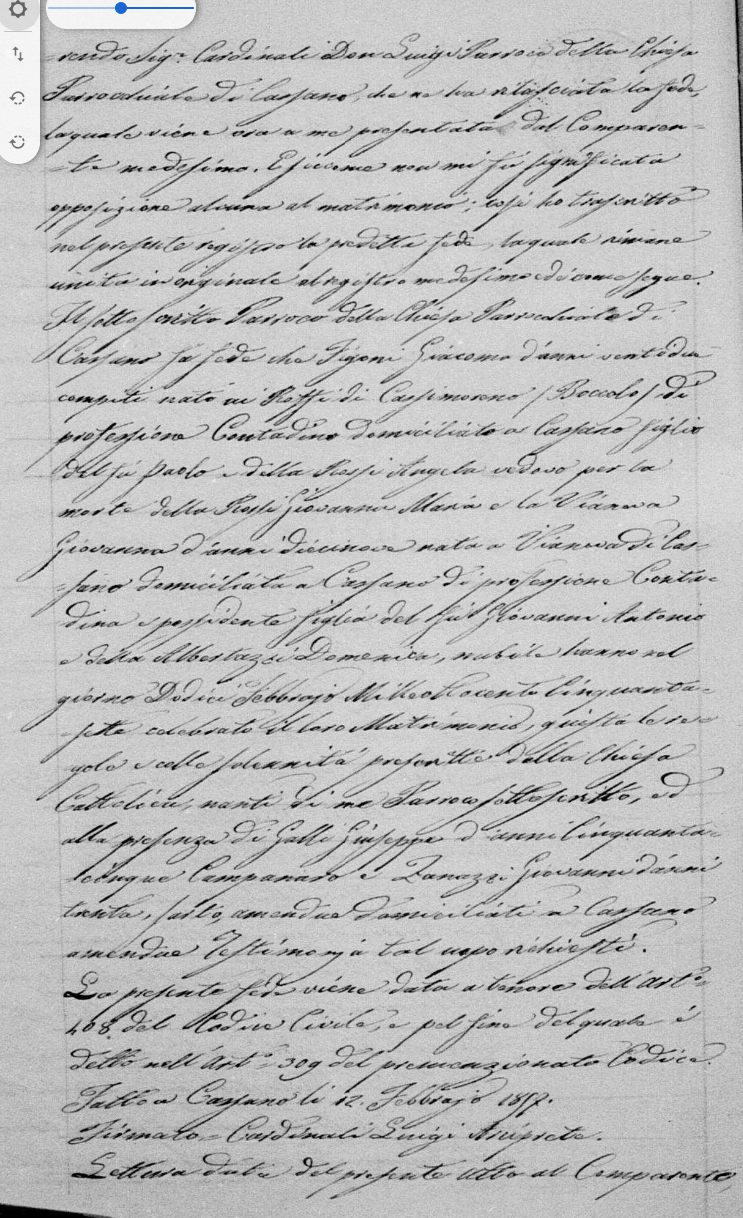
He married Margherita Poggi of Riva — a young woman of 18, already without a father, living with her widowed mother Giovanna. Her occupation was given as proprietaria — she was from a family that owned land, not rented it. This was a step up for Pietro. The marriage was performed civilly at Ponte dell'Olio and then religiously the same day at the church of San Matteo di Oliva at Riva, by Don Giuseppe Agosto. His mother Rosa was already dead. His father Giuseppe was still alive.
Sposò Margherita Poggi di Riva — una giovane donna di 18 anni, già senza padre, che viveva con la madre vedova Giovanna. La sua occupazione era indicata come proprietaria — proveniva da una famiglia che possedeva terra, non la affittava. Era un passo avanti per Pietro. Il matrimonio fu celebrato civilmente a Ponte dell'Olio e poi religiosamente lo stesso giorno nella chiesa di San Matteo di Oliva a Riva, da Don Giuseppe Agosto. Sua madre Rosa era già morta. Suo padre Giuseppe era ancora vivo.
Their son Emilio was born on 25 August 1858, at Travo — eighteen months after the wedding. He was born on the same hillside where his father and grandfather had been born. He grew up hearing the same river, watching the same chestnuts ripen in the same autumn light. Then, in his early twenties, he left.
Il loro figlio Emilio nacque il 25 agosto 1858, a Travo — diciotto mesi dopo il matrimonio. Nacque sullo stesso versante dove erano nati suo padre e suo nonno. Crebbe sentendo lo stesso fiume, guardando gli stessi castagni maturare nella stessa luce autunnale. Poi, nei suoi primi anni venti, partì.
· · ✦ · ·
Chapter Four
Capitolo Quarto
Emilio — the road out of the valley
Emilio — la strada fuori dalla valle
Emilio Romeo Sante Bassi was born in 1858 into a country that did not yet fully exist. Italy became a unified kingdom in 1861, when he was three years old. The unification brought new taxes, new conscription laws, a new insistence on national service from men who had spent their whole lives thinking of themselves as inhabitants of a valley, not citizens of a nation. It also brought the slow spread of roads and railways — and with them, the knowledge that there were cities, and that cities needed labour, and that the land of the Apennines could not support its children indefinitely.
Emilio Romeo Sante Bassi nacque nel 1858 in un paese che non esisteva ancora pienamente. L'Italia divenne un regno unificato nel 1861, quando aveva tre anni. L'unificazione portò nuove tasse, nuove leggi sulla coscrizione, una nuova insistenza sul servizio nazionale da uomini che avevano trascorso tutta la vita pensando a se stessi come abitanti di una valle, non come cittadini di una nazione. Portò anche la lenta diffusione di strade e ferrovie — e con esse, la consapevolezza che esistevano le città, e che le città avevano bisogno di manodopera, e che la terra degli Appennini non poteva sfamare indefinitamente i suoi figli.
The exodus from the Apennine valleys began in earnest in the 1870s and 1880s. Attilio Carboni described it simply: the exodus of our people toward the cities has depopulated the mountain. It was still happening in his own lifetime, a century later. But the first great wave washed out of the valleys in Emilio's generation. Genoa was the nearest large city, reachable by the Napoleonic road through Travo — the road Harriet Parry had ridden in 1819, the road Caproni would take a bus along in 1947. Genoa was also a port. And from a port, you could go anywhere.
L'esodo dalle valli appenniniche iniziò sul serio negli anni 1870 e 1880. Attilio Carboni lo descrisse semplicemente: l'esodo della nostra gente verso la città ha spopolato la montagna. Stava ancora accadendo nella sua vita, un secolo dopo. Ma la prima grande ondata si riversò fuori dalle valli nella generazione di Emilio. Genova era la città più grande più vicina, raggiungibile per la strada napoleonica attraverso Travo. Genova era anche un porto. E da un porto si poteva andare ovunque.
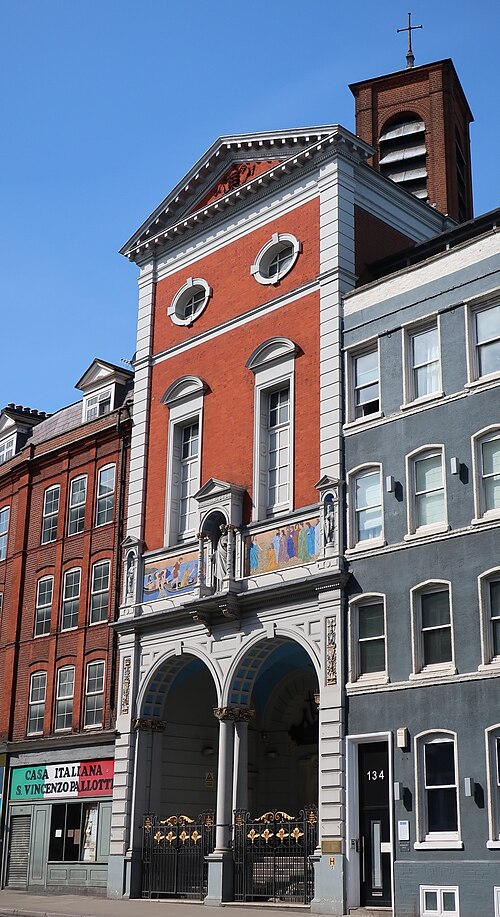
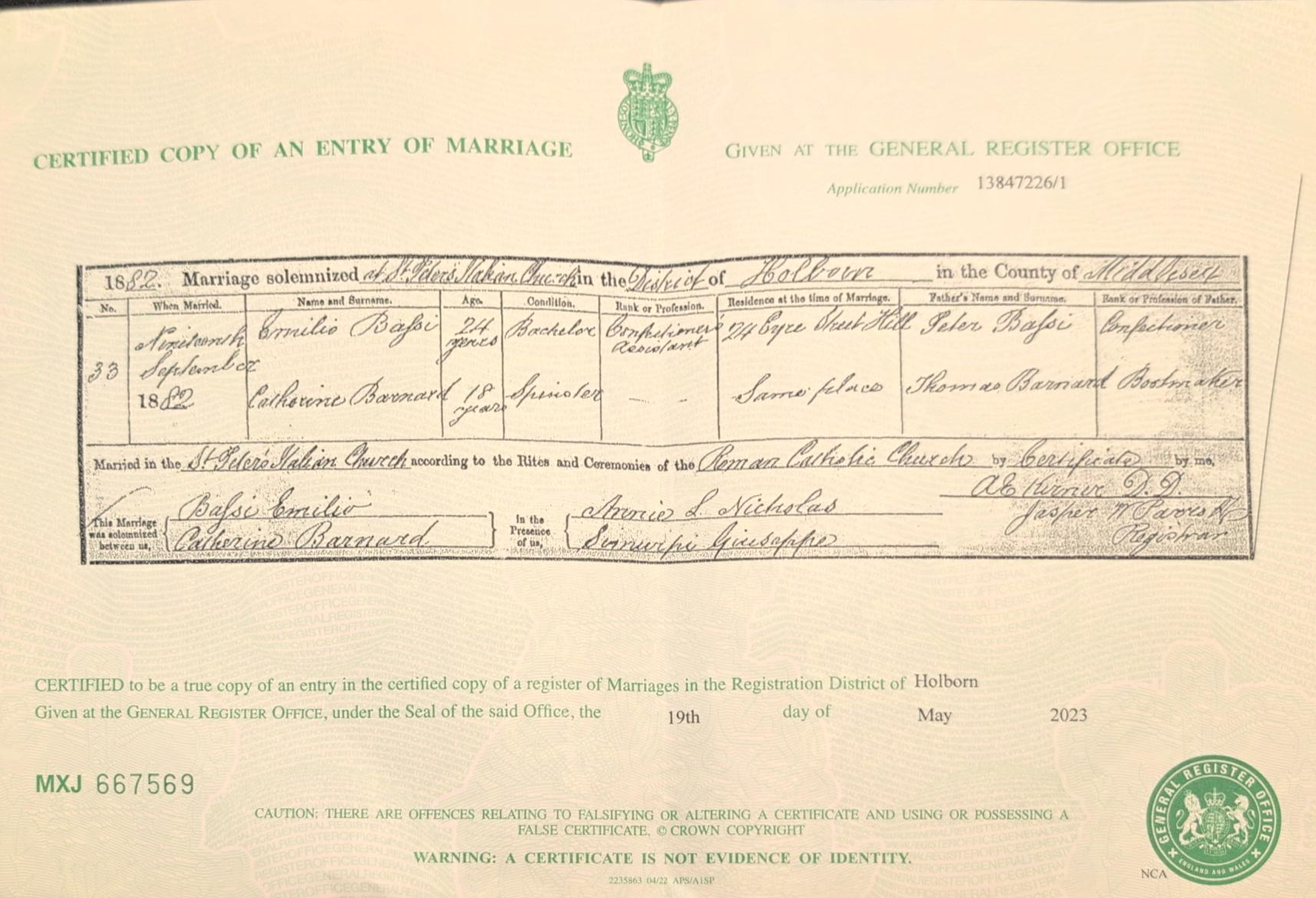
We do not know exactly when Emilio left, or which road he took, or who he said goodbye to. We know only that by September 1882 he was in London, living at 74 Eyre Street Hill in Clerkenwell — a street in the heart of the Italian immigrant quarter — and that on 19 September 1882 he married Catherine Barnard at St Peter's Italian Church, the church that the Italian community had built for itself in 1863. He was perhaps 23. She was 18, born in London to a father from Pimlico and a mother from Ireland. Her niece, who later lived with them, was a Macnamara — Catherine's own family was half Irish. At the Italian church on Clerkenwell Road, a man from the mountains of Piacenza married a woman from the streets of London, and two Catholic communities that had both washed up in this city by different routes became one family.
Non sappiamo esattamente quando Emilio partì, né quale strada prese, né da chi si congedò. Sappiamo solo che nel settembre 1882 era a Londra, al 74 di Eyre Street Hill a Clerkenwell — una strada nel cuore del quartiere degli immigrati italiani — e che il 19 settembre 1882 sposò Catherine Barnard nella chiesa italiana di San Pietro, la chiesa che la comunità italiana si era costruita nel 1863. Aveva forse 23 anni. Lei ne aveva 18, nata a Londra da un padre di Pimlico e una madre irlandese.
He worked as a cab driver. He saved. He built a small business — ice cream barrows and a fruit stall, the classic occupations of Italian immigrants in Victorian London. He lived in Brixton and then Clapham, in the tight community of South London Italians. His wife Catherine ran a fruit and nut stall at the corner of Stockwell Road.
Lavorò come cocchiere. Risparmiò. Costruì un piccolo commercio — carretti di gelati e una bancarella di frutta, le occupazioni classiche degli immigrati italiani nella Londra vittoriana. Viveva a Brixton e poi a Clapham, nella stretta comunità degli italiani del South London. Sua moglie Catherine gestiva una bancarella di frutta e noci all'angolo di Stockwell Road.
Then, on Saturday 2 October 1897, a former employee named Antonio Scotti waited for him near the Swan public house and stabbed him in the back between the ribs. Scotti had worked for Emilio for four months, lived in his house, been given his own key. He had been dismissed for laziness and replaced. He claimed Emilio owed him money. The court did not believe him.
Poi, sabato 2 ottobre 1897, un ex dipendente di nome Antonio Scotti lo aspettò vicino al pub Swan e lo accoltellò alla schiena tra le costole. Scotti aveva lavorato per Emilio per quattro mesi, viveva in casa sua, aveva avuto la propria chiave. Era stato licenziato per pigrizia e sostituito. Sosteneva che Emilio gli dovesse dei soldi. Il tribunale non gli credette.
Emilio survived. He recovered enough to appear at the Old Bailey on 13 December 1897, where he gave his deposition — through an interpreter. He had lived in London since around 1880. He had been in England for approximately seventeen years. He still could not speak English well enough to give evidence without help. The valley was still in him, in the language he thought in, in the words that came first.
Emilio sopravvisse. Si riprese abbastanza da comparire all'Old Bailey il 13 dicembre 1897, dove rese la sua deposizione — tramite interprete. Viveva a Londra dal 1880 circa. Era in Inghilterra da circa diciassette anni. Non parlava ancora l'inglese abbastanza bene da testimoniare senza aiuto. La valle era ancora in lui, nella lingua in cui pensava, nelle parole che venivano prima.
"I went towards the urinal and saw Scotti — I said, 'You have no work to-day' — he made no answer, and as I went out of the urinal I felt something in my back — for a second I did not know what it was — I turned and saw Scotti — I went to strike him, and knocked his hat off, and he ran away — I found I was bleeding, and I called to my missus, 'Stop him, stop him.'"
Emilio Bassi · Old Bailey, 13 December 1897 · ref: t18971213-86
Scotti was sentenced to five years penal servitude. Emilio went back to his stall, his barrows, his cab. But the wound had done damage that did not fully heal. In 1904 he contracted tuberculosis. On 25 April 1905, at the Brompton Hospital for Consumption in Kensington — the hospital where Victorian London sent its tuberculosis patients to die — Emilio Romeo Sante Bassi died. He was 47. His wife Catherine was 40. She would live another fifty years.
Scotti fu condannato a cinque anni di lavori forzati. Emilio tornò alla sua bancarella, ai suoi carretti, al suo cab. Ma la ferita aveva fatto danni che non guarirono del tutto. Nel 1904 contrasse la tubercolosi. Il 25 aprile 1905, al Brompton Hospital for Consumption di Kensington — l'ospedale dove la Londra vittoriana mandava i suoi malati di tubercolosi a morire — Emilio Romeo Sante Bassi morì. Aveva 47 anni. Sua moglie Catherine ne aveva 40. Avrebbe vissuto altri cinquant'anni.
He never went back to Travo. He never saw Villa Gattavera again. The hillside at Dinavolo, the stone terraces, the chestnut forests above the river — he left them when he was perhaps twenty-two, and he never returned.
Non tornò mai a Travo. Non rivide mai Villa Gattavera. Il versante di Dinavolo, i terrazzamenti di pietra, i boschi di castagni sopra il fiume — li lasciò quando aveva forse ventidue anni, e non tornò mai.
· · ✦ · ·
For Evelina —
Per Evelina —
You are the seventh generation of this family. The first generation, Giuseppe and Rosa, are separated from you by nearly two hundred years. They lived on a hillside above a river in the mountains of northern Italy. They farmed the same small strips of ground that their parents and grandparents had farmed before them. They buried most of their children. They did not know that one of those children — Pietro — would have a son who would walk out of the valley one day and never come back, and that this son's son's son's son would eventually have a daughter called Evelina.
Sei la settima generazione di questa famiglia. La prima generazione, Giuseppe e Rosa, è separata da te da quasi duecento anni. Vivevano su un versante sopra un fiume nelle montagne dell'Italia settentrionale. Coltivavano le stesse piccole strisce di terra che i loro genitori e nonni avevano coltivato prima di loro. Seppellirono la maggior parte dei loro figli. Non sapevano che uno di quei figli — Pietro — avrebbe avuto un figlio che un giorno sarebbe uscito dalla valle e non sarebbe mai tornato, e che il figlio del figlio del figlio di questo figlio avrebbe avuto infine una figlia chiamata Evelina.
The hillside at Dinavolo is still there. The name Gattavera is still on the maps. The Catasto Ducale — the great land survey commissioned by Maria Luigia of Austria when Pietro was a baby — shows the plot boundaries of the land your family farmed, the individual fields held up by the stone walls they built. The Trebbia still runs clear over limestone below. The chestnuts still grow above.
Il versante di Dinavolo è ancora lì. Il nome Gattavera è ancora sulle mappe. Il Catasto Ducale — il grande rilevamento catastale commissionato da Maria Luigia d'Austria quando Pietro era un bambino — mostra i confini degli appezzamenti della terra che la tua famiglia coltivava, i singoli campi sostenuti dai muri di pietra che costruirono. Il Trebbia scorre ancora limpido sulla pietra calcarea in basso. I castagni crescono ancora in alto.
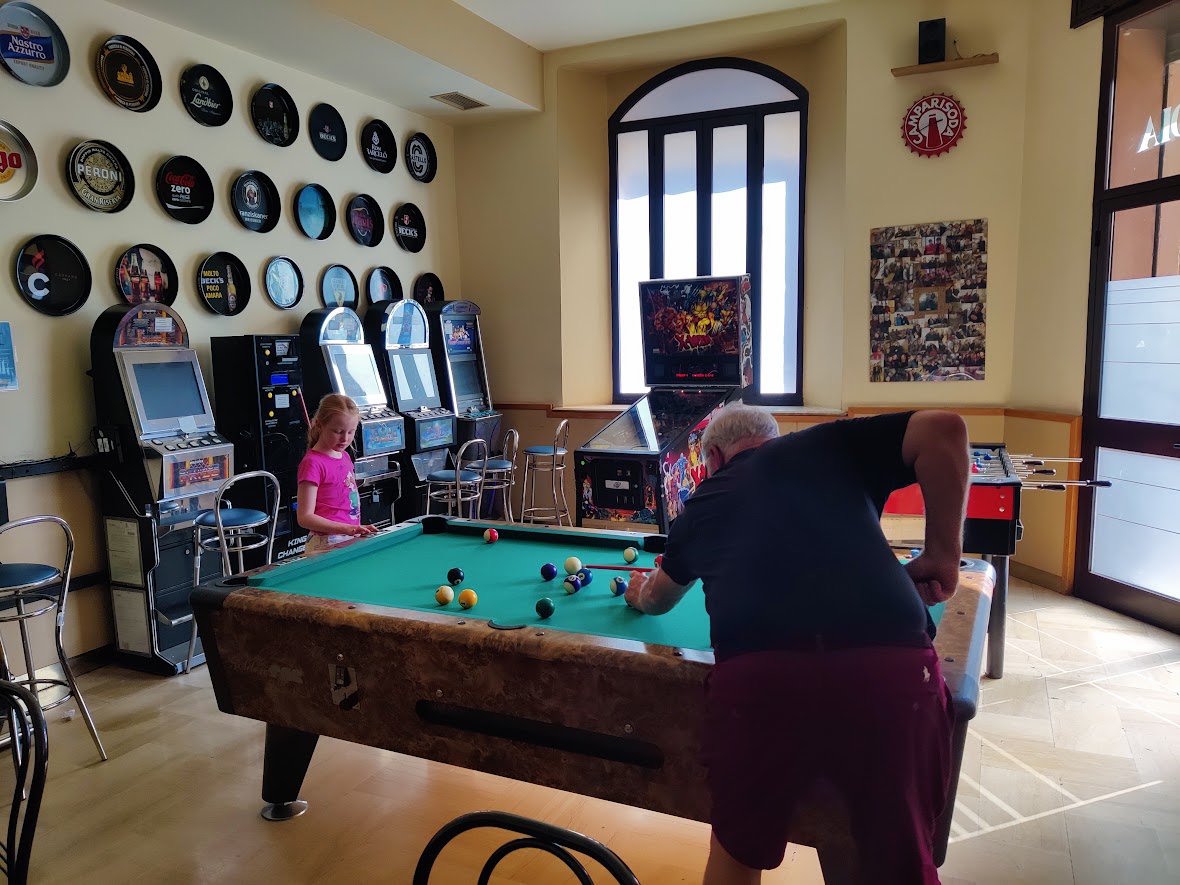
We went there in 2024, you and I. We sat in the bar in Travo. You were eight years old. You did not know that you were sitting in the village where your great-great-great-grandfather Pietro was born in 1830, in the valley that his son Emilio left for London in 1880 and never came back to. Now you know. The valley is yours too.
Ci siamo andati nel 2024, tu ed io. Ci siamo seduti nel bar di Travo. Avevi otto anni. Non sapevi di essere seduta nel paese dove il tuo trisavolo Pietro nacque nel 1830, nella valle che suo figlio Emilio lasciò per Londra nel 1880 e dalla quale non tornò mai. Ora lo sai. La valle è anche tua.
With love — Steve, March 2026
Con affetto — Steve, marzo 2026